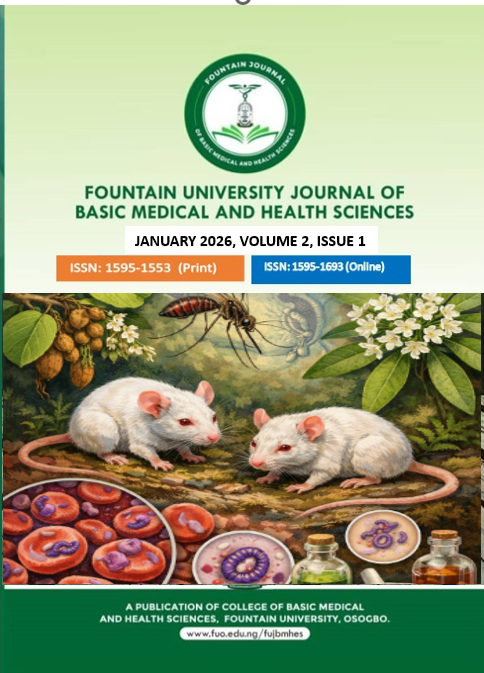
Antiparasitic Activity of Piliostigma thonningii and Alstonia boonei on Malaria-Infected Albino Mice
Keywords:
Parasitaemia, Standard drug, Plant extract, Saponins, Anthraquinones, ChloroquineAbstract
Background: Malaria is a significant parasitic disease in Nigeria and across Africa, posing a risk to everyone. Objective: The study assessed the in vivo antiplasmodial activity of the aqueous extracts of Piliostigma thonningii and Alstonia boonei, and their combinations, against malaria infection in albino mice. Methodology: The in vivo antiplasmodial activity of aqueous extracts of Piliostigma thonningii and Alstonia boonei, alone and in combination, was assessed against chloroquine-sensitive Plasmodium berghei in mice. Curative assays were conducted on established infections via orogastric administration (0.2-0.6 ml). Chloroquine and distilled water served as positive and negative controls, respectively. Results: Phytochemical analysis revealed the presence of various compounds such as saponins, flavonoids, alkaloids, phenolics, glycosides, anthraquinones, tannins, and steroids in both plant extracts. There was a significant reduction in parasitaemia loads after treatment, particularly with the combined extract, which exhibited the highest curative effect. No significant differences were observed in body weight (15.0±0.59, 17.4±0.65, 19.0±5.96, 17.6±2.27, 15.0±5.25, 19.0±5.96, 15.3±1.41, 14.5±0.41, 16.8±1.68, 15.1±1.00) and temperature (35.3±0.25, 36.2±0.12, 36.7±0.53, 36.3±0.92, 35.3±0.25, 36.3±1.14, 35.0±0.43, 35.3±1.35, 36.1±0.98, 36.9±1.55) among the treatment groups, respectively. Overall, the combined plant extracts demonstrated promising anti-malarial activity compared to individual extracts and the standard drug. Conclusion: In conclusion, the present study showed that the aqueous extracts of the two medicinal plants are potent in causing a reduction in malaria parasite load. The findings from this study showed that the two herbs (Alstonia boonei and Piliostigma thonningii) are promising antimalarial herbs and could be explored in the manufacture of potent antimalarial drugs. Recommendations: Future research could centre on isolating and identifying the specific bioactive compounds responsible for the antiplasmodial activity, investigating their mechanisms of action, and also evaluating the extracts against drug-resistant Plasmodium strains.